
COLOUR FIELDS LEFT
/DAY 3 – SATURDAY 12 OCTOBER
|
11.00 am
|
Ster Century Cinema | |||
| 1.30 pm | Ster Century Cinema | |||
| 4.00 pm | Ster Century Cinema | |||
| 8.00 pm |
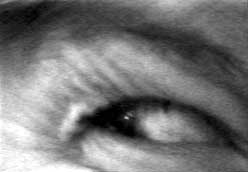
SKETCHES
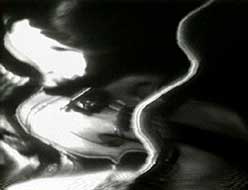
VIOLIN POWER

MIRRORED REASON
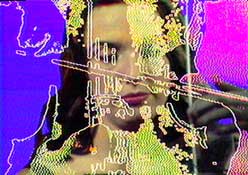
GLOBAL GROOVE
FEEDBACK:
Performance in Early Video
Venue: Ster Century Cinema
Time: 11 am
Ranging from Pepsi commercials interweaved with Korean dancing to a human
face concert and a video played through a violin. This specially curated
programme of films, introduced by John Thomson from New York based E.A.I.
(Electronic Arts Intermix), will feature the work of early performance
video artists Steina and Woody Vasulka, Stan VanDerBeek, Nam June Paik
and John Godfrey. The relationship between art and technology can be symbiotic,
combative or accidental. Feedback considers this complex relationship
in the context of the innovators that helped establish video as an art
form. These artists were not afraid to take technological risks, their
vision was outward and innovative, they embraced the world around them,
critiquing its culture, ideas and aesthetics. Their strategy was to participate
in the development of new technologies, rather than just apply their artistic
practice to systems they had been allowed to access.
Download FEEDBACK: Performance in Early Video, an essay by John
Thomson commissioned by Lumen for Evolution 2002: PROCESS
 Download*
PDF (14k)
Download*
PDF (14k)
Films:
SKETCHES, Steina and Woody Vasulka
RED ROSES, 1970, b&w
LET IT BE, 1970, b&w
THE KISS, 1970, b&w
CHARLES' STORY,1970, b&w
ALFONS, 1970, b&w
THIERRY, 1970, b&w
GUNDANCE, 1970, b&w
Steina and Woody Vasulka are pioneers who have contributed to the evolution
of video art. The Vasulkas' investigations into analog and digital processes
and their development of electronic imaging tools, which began in the
early 1970s, place them among the primary architects of an expressive
electronic vocabulary of image–making. They chart the evolving formulation
of a syntax of electronic imaging as they articulate a processual dialogue
between artist and technology.
The Vasulkas capture the counter cultural spirit
of the era in a series of performances by Jackie Curtis, Steina, Charles
Hayworth, Helen Wong, Alfons Schilling, Thierry Benizeau and Daniel Nagrin.
These "sketches" also reveal the Vasulkas' early experiments
with electronic image manipulation. (Extract from the EAI online catalogue:
www.eai.org)
VIOLIN POWER, Steina Vasulka, 1970–78, 10:04 min, b&w,
sound
Steina terms this procedural work "a demo tape on how to play video
on the violin." Her background as a violinist and her evolution from
musician to visual artist is referenced through an analogy of video camera
to musical instrument. Steina is first seen in footage from the early
1970s, playing the violin and singing to The Beatles' Let It Be. As succeeding
segments trace a chronological progression, Steina layers imagery and
time. The violin itself ultimately becomes an image generating tool, as
she connects it to imaging devices, creating abstract visual transpositions
of sound and vibrations. This unconventional self–portrait is a study
of the relationship of music to electronic image. (Extract from the EAI
online catalogue: www.eai.org)
STAN VANDERBEEK: SELECTED WORKS
COLOUR FIELDS LEFT, 1977, 7:47
min, colour, sound
MIRRORED REASON, 1979, 9:22
min, colour, sound
FACE CONCERT, 1981, 11:54 min,
colour, sound
A pioneer in the development of experimental film and live–action
animation techniques, Stan VanDerBeek achieved recognition in the American
avant–garde cinema. Advocating a utopian fusion of art and technology,
he produced theatrical, multimedia experiments that included projection
systems, dance, planetarium events and the exploration of early computer
graphics and image–processing systems.
A study in analogue imaging and the relation of
sound to image, Colour Fields Left merges moving bands of colour with
electronic sounds in an increasingly complex pattern. A Kafka–inspired
tale, Mirrored Reason tells the story of a woman who is haunted and eventually
replaced by her double. Face Concert is an ode to human expression in
which Vanderbeek transforms the face into a visual canvas. (Extract from
the EAI online catalogue: www.eai.org)
GLOBAL GROOVE, Nam June Paik and John Godfrey, 1973, 28:30 min,
colour, sound
Nam June Paik is a seminal figure in video art. His video sculptures,
installations, performances and tapes encompass one of the most influential
bodies of work in the medium. Merging global communications theories with
an irreverent Fluxus sensibility, his electronic collages explore the
juncture of art, technology, and popular culture, as he interweaves avant–garde
figures, pop icons and electronic processing.
"This is a glimpse of the video landscape
of tomorrow, when you will be able to switch to any TV station on the
earth, and TV Guide will be as fat as the Manhattan telephone book."
So begins Global Groove, a seminal tape in the history of video art. This
radical manifesto on global communications in a media–saturated world
is rendered as a frenetic electronic collage, a sound and image pastiche
that subverts the language of television. With surreal visual wit and
an antic neo–Dada sensibility, Paik manipulates an emblematic pastiche
of multicultural elements, art world figures and Pop iconography.
Pepsi commercials appropriated from Japanese television
are juxtaposed with performances by avant–garde artists John Cage,
Merce Cunningham, Allen Ginsberg and the Living Theatre; dancers moving
in a synthesized, colorized space to Mitch Ryder's Devil with a Blue Dress
On are intercut with traditional Korean dancers. Charlotte Moorman, her
image wildly synthesized, plays the TV Cello; Paik and Moorman play the
TV Bra for Living Sculpture; Richard Nixon's face is distorted by a magnetically
altered television. In an ironic form of interactive television, Paik
presents "Participation TV," in which he instructs viewers to
open or close their eyes. Paik subjects this transcultural, intertextual
content to an exuberant, stream–of–consciousness onslaught of
disruptive editing and technological devices, including audio and video
synthesis, colorization, ironic juxtapositions, temporal shifts and layering
–– a controlled chaos that suggests a hallucinatory romp through
the channels of a global TV. With its postmodern content, form and conceptual
strategies, Global Groove has had a profound influence on video, television
and contemporary art. (Extract from the EAI online catalogue: www.eai.org)
Contributors:
ELECTRONIC ARTS INTERMIX (E.A.I, www.eai.org)
Electronic Arts Intermix (E.A.I.) was founded in 1971 by Howard Wise,
an innovative art dealer and visionary supporter of video as art, as one
of the first non–profit organizations dedicated to the support of
video as an art form. EAI is now one of the world's leading resources
for artists' video and new media.
JOHN THOMSON
John Thomson is the Director of Distribution at EAI, he has curated programmes
for the Lux Centre (London) and co–ordinated the Pandaemonium Festival
(1998). He has lectured at Central St Martins and Camberwell College of
Arts (London), and the School of Visual Arts (New York).
PROCESS | THEORY | PRACTICE
Produced by the AHRB’s CentreCATH
Venue: Ster Century Cinema
Time: 1.30 pm
This open discussion, produced for Evolution by the AHRB’s CentreCATH,
will aim to widen the context for the debate on art, technology and process
to encompass philosophy, culture and the mind. The advent of new technologies
and their impact on the domains of media and art practice has undeniably
been profound. The work of practitioners in these domains – in particular
multi–media and audio–visual film – has led to new possibilities
for expression and new relationships between theory and practice. Contributors
to this seminar will also consider how the practices of multi–media
and experimental film have a history which extensively pre–dates
the more recent technological developments. The panel of artists, academics
and theoreticians will include Marcel Swiboda, Malcolm Le Grice, Drew
Hemment and Tiziana Terranova.
Contributors:
CENTRECATH (AHRB Centre for Cultural Analysis Theory and History)
The Arts and Humanities Research Board (AHRB) funds postgraduate and advanced
research within the UK's higher education institutions and provides funding
for museums, galleries and collections that are based in, or attached
to, higher education institutions within England. AHRB CentreCATH is one
of a number of AHRB Research Centers which provide a focus for research
activity in a field of study that is of strategic importance within a
wider subject or disciplinary area.
DREW HEMMENT
(www.futuresonic.com)
Drew Hemment is director and founder of Futuresonic, the UK's annual festival
of electronic music and audiovisual arts, as well as a freelance writer,
curator and producer. He has been involved in innovative event production
since the late 80s, and was involved in the development of dance culture
in the UK during the late 80s and early 90s. He studied Continental Theory
(MA) at Warwick University and subsequently completed a PhD on the contemporary
experience of sound at Lancaster University.
SIMON O SULLIVAN (Chair) is lecturer in Art History and Visual
Culture at Goldsmiths College. His research and publications are in the
area of aesthetics, art history and poststructuralist theory.
LUCIANA PARISI lectures in Media Studies in the Department of Cultural
Studies , University of East London. She has published various essays
on affect and the body especially in relation to science and technology.
She is currently completing her book, 'Abstract Sex : An Intensive Body
from Molecular biology to Biotechnologies'.
MARCEL SWIBODA is finishing a PhD in Cultural Studies at the University
of Leeds, England. He was the co-editor of the journal Parallax for two
years and commissioned a themed issue on thinking process and its relation
to a variety of disciplines and practices, called ‘Immanent Trajectories’.
Future publications are to include an article on music, technology and
the political, using the philosophy of Gilles Deleuze and Félix
Guattari to examine the role of material and semiotic process in the ‘electric’
period of the African-American jazz musician Miles Davis, and an article
on the work of Guattari in the re-theorization of the relationship between
process and language.
TIZIANA TERANOVA (http://www.essex.ac.uk/sociology/department/people/socterranova.htm)
lectures in the sociology of culture, media and film in the Department
of Sociology University of Essex. Her published work mainly concerns the
cultural politics of networked societies. She is currently completing
a book entitled 'Network Culture: Collective Politics in Control Societies'.

AURORA BOREALIS (Northern Lights)

SILENT KEY
NATURAL PROCESSES
Produced by Huddersfield University (Derek Hales)
Venue: Ster Century Cinema
Time: 4 pm
A live performance of Silent Key, David Ellis’ radio–inspired
sound montage of broadcast clichés, composed music, clicks, dictaphonics
(commissioned by BBC radio drama for 'Between The Ears', Radio 3), and
interviews will open this seminar examining invisible and ambient phenomena
from wireless networks to the spectacular Aurora Borealis (Northern Lights).
The spectacle of exchange can be surveyed in the movement of these bodies:
Our network transactions are measured and calibrated – but their
frequency, temperature and noise rupture our experience, puncture our
moods and punctuate our lives – inscribing space and place with ambient
fields. A panel of scientists and artists including Derek Hales, Robert
Whitman and Maja Kuzmanovic (FoAm) will look at these mysterious electromagnetic
landscapes and data–clouds through the lens of contemporary processes
in art and architecture.
Contributors:
'FoAM (www.f0.am) is
an independent, distributed laboratory based on multidisciplinary models
of cultural expression, operating on the cusp of research, production,
presentation and reflection of creative practices. FoAM aims to become
an 'edge-habitat', working within a network of partner organisations,
toward a symbiosis of culture and science, technology and nature... exploring
evolution and interaction of dynamic systems, expanding public contexts
for active participation of all 'players' involved.' (FoAM website)
DEREK HALES (Chair) is Head of Digital research at the University
of Huddersfield, convenor of the Digital Futures Group for the Royal Institute
of British Architects and the chair of Lumen’s board of directors.
He is an architect and academic currently conducting research into the
impact of digital technologies on architecture and urban space.
MAJA KUZMANOVIK (www.f0.am)
is an artist-researcher, founding member and director of FoAM. Prior to
founding FoAM, Maja focused on non-conventional research and the application
of several technologies, ranging from internet to mixed reality and fully
immersive CAVE environments. She has been elected as one of the Top 100
Young Innovators by MIT‚s Technology Review and has worked in residency
within several European Research Centres, such as Starlab in Brussels,
the Dutch National Centre for Mathematics and Computer Science (CWI) in
Amsterdam and the German National Institute for Information Technology
(GMD) in Sankt Augustin.

LINE DESCRIBING A CONE

LIGHT MUSIC

EIFFEL TRIFLE
EXPANDED CINEMA:
Films from the London Film Makers Co–operative
Venue: (Above) The Wardrobe bar, Leeds
Time: 8 pm
Audience participation will be required at this screening of experimental films produced in the 1970’s by film–makers at the London Film Makers Co–operative (www.lfmc.org). Founded in 1965/66 the London Film Makers Co–Operative produced some of the first experimental films in the UK. During Line Describing a Cone by Anthony McCall, viewers are invited to stand with their back to the screen, moving in and out of a projected light beam as it gradually builds up a hollow cone of light around them. This selection of work explores the material qualities of film and its recording, processing and projection whilst questioning the role of the audience. This programme will be introduced by John Thomson from New York based E.A.I. (Electronic Arts Intermix), one of the world’s leading resources for artists’ video.
Films:
LINE DESCRIBING A CONE, Anthony McCall, 1973, 30 min, b/w, silent
"In Line describing a cone, the conventional primacy of the screen is completely abandoned in favour of the primacy of the projection event. According to McCall, a screen is not even mandatory. He succinctly describes the film: ‘The viewer watches the film, by standing with his, or her, back towards what would normally be the screen, and looking along the beam towards the projector itself. The beam begins as a coherent line of light, like a laser beam, and develops through the 30 minute duration into a complete, hollow cone of light.
The audience is expected to move up and down, in and out of the beam – this cannot be fully experienced by a stationary spectator. The shift of image as a function of shift of perspective is the operative principle of the film. External content is eliminated, and the entire film consists of the controlled line of light emanating from the projector; the act of appreciating the film – i.e., ‘the process of its realisation’ – is the content." (Deke Dusinberre, Studio International, Nov/Dec 1975)
LIGHT MUSIC, Lis Rhodes, 1975–77, 20 min, b/w, sound
Lis Rhodes has conducted a thorough investigation into the relationship between shapes and rhythms of lines and their tonality when printed as sound. Her latest work, Light Music, is in a series of movable sections. The film does not have a rigid pattern of sequences and the final length is variable. The imagery is restricted to lines of horizontal bars across the screen: there is variety in the spacing (frequency), their thickness (amplitude), and their colour and density (tone). (William Raban, extract from programme notes for Perspectives on British Avant–Garde at Hayward Gallery, 1977)
EIFFEL TRIFLE, Paul Botham, 1972, b/w, 2 screens, 8 mins
'In 1972 I burrowed myself into Paris with an even stronger determination, this time not for all of Paris, just to steal her ‘diamond’, the Eiffel Tower. My Bolex; sound recording film;… a technology to contrast this identifiable subject. Here banked against the monumentous image, I had to form a rigorous emphasis around my now accumulated processing data. In trying to attribute a visual rhyme in film on the baroqueness of geometrical animation, this film has languaged its own Sound/Silence.' (Paul Botham)